 Martha Alizo
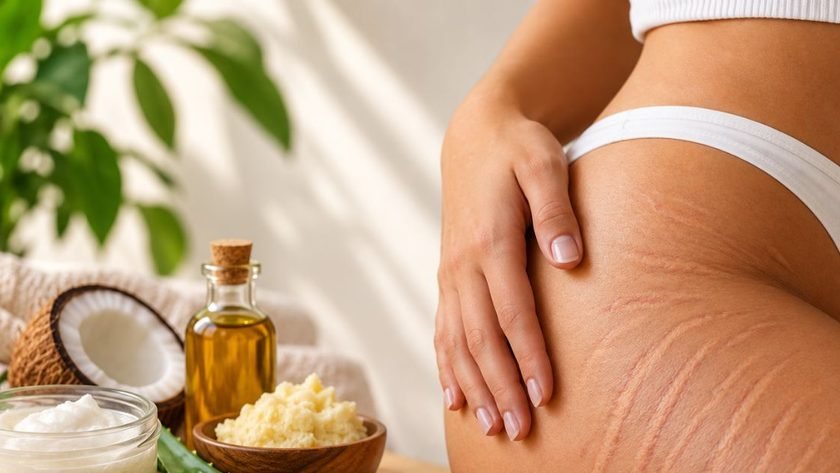
Stretch marks are stubborn. You can moisturize them every day, try different body oils, exfoliate regularly, and still look down months later and see those familiar lines across your stomach, thighs, hips, breasts, or arms.
Part of the frustration comes from how stretch marks are usually discussed online. Search for natural treatments, and you’ll find everything from cocoa butter and aloe vera to lemon juice, coffee scrubs, egg whites, and essential oils. Some are useful for keeping stretched skin soft and comfortable. Others have very little evidence behind them.
There’s also an important limit to what any natural treatment can do: stretch marks are a form of scarring. They develop when rapid stretching or shrinking disrupts collagen and elastin within the skin. Once those structural changes have happened, an oil or homemade remedy can’t simply erase them. The American Academy of Dermatology notes that stretch marks are permanent, although they usually become less noticeable with time, and certain treatments can improve their appearance.
That doesn’t make natural skincare pointless. The right approach can keep the area moisturized, reduce dryness and itching, support normal skin function, and help you avoid wasting money on remedies that promise far more than they can deliver.
Here are 13 natural treatments and habits worth considering, along with what you should realistically expect from each one.
Best Natural Treatments for Stretch Marks
1. Aloe Vera
Aloe vera is probably one of the first ingredients you’ll come across when looking for natural stretch mark treatments.
Its biggest advantage is simple: it can be soothing and moisturizing.
Fresh stretch marks sometimes feel itchy or uncomfortable, particularly when the skin is changing quickly. Applying a gentle aloe vera gel can help keep the surface hydrated and may feel soothing on irritated skin.
What aloe hasn’t been proven to do is remove an established stretch mark.
Claims that aloe “regenerates” the damaged skin enough to erase stretch marks go beyond the available evidence. You can still include it in your routine, but think of it as supportive skincare rather than a scar-removing treatment.
If you’re buying aloe gel rather than using it directly from the plant, check the ingredient list. Some products contain alcohol, fragrance, dyes, or other ingredients that may irritate sensitive skin.
Apply a thin layer to clean skin and allow it to absorb before using a moisturizer if your skin still feels dry.
2. Hyaluronic Acid
Hyaluronic acid is one of the more interesting options on this list because there is at least some research behind its use on early stretch marks.
This acid naturally occurs in the skin and has a remarkable ability to bind water. In skincare, it works primarily as a humectant, helping the outer layers of your skin hold onto moisture.
The American Academy of Dermatology reports that two large studies found applying hyaluronic acid to early stretch marks made the marks less noticeable.
The word early matters.
A fresh reddish, pink, purple, or darker stretch mark isn’t the same as a mature white or silvery one. Older stretch marks have undergone more permanent structural changes and tend to be harder to treat.
For home use, apply a hyaluronic acid serum or body product to slightly damp skin, then follow with a moisturizer to help seal in that hydration.
Don’t expect your normal facial hyaluronic acid serum to erase mature stretch marks. The evidence is promising enough to make hyaluronic acid worth considering, particularly for newer marks, but it isn’t a cure.
MUST READ==> 11 Simple Beauty Tweaks That Can Make You Look Absolutely Gorgeous
3. Centella Asiatica
Centella asiatica, sometimes called cica or gotu kola, has become common in skincare products, but its use isn’t limited to trendy face creams.
It’s also one of the botanical ingredients that have been studied for stretch marks.
Centella contains compounds that have been investigated for their effects on wound healing and collagen-related processes in the skin. Some research on topical preparations containing centella has suggested possible benefits in reducing the development of stretch marks, although the evidence isn’t strong enough to guarantee prevention or removal.
That’s a much more realistic reason to consider centella than the exaggerated claim that it will “heal stretch marks naturally.”
Look for a properly formulated body cream or moisturizer containing centella rather than attempting to create concentrated herbal preparations yourself.
If you’re pregnant and using a product marketed for stretch marks, check the complete ingredient list rather than assuming the entire formula is pregnancy-safe simply because centella is included.
4. Shea Butter
Shea butter is excellent at doing something much less dramatic but genuinely useful: keeping dry skin soft.
It’s rich and occlusive, making it particularly suitable for areas such as the stomach, thighs, hips, buttocks, and breasts where skin may feel tight or dry.
Shea butter helps reduce moisture loss from the surface of the skin. That can improve softness and make dry stretch-marked skin look temporarily smoother.
What it can’t reliably do is reconstruct the damaged collagen and elastin responsible for the scar.
This is an important distinction because many stretch-mark creams use rich butters as their main ingredients and then attribute fading to the butter itself.
If you enjoy shea butter, use it.
Apply a small amount after bathing, preferably while your skin still has a little moisture on it. You can also layer it over a lighter hydrating lotion if your skin is particularly dry.
5. Coconut Oil
Coconut oil gets recommended for almost every body-care concern, and stretch marks are no exception.
It can be useful here, but mostly as an emollient.
Coconut oil helps soften skin and reduce moisture loss. If your stretch marks feel dry or itchy, applying a small amount after bathing may make the area feel more comfortable.
There isn’t good evidence showing that coconut oil removes existing stretch marks.
That doesn’t make it useless. It simply means its real benefit is different from the one often advertised.
Use virgin coconut oil sparingly on damp skin, or layer it over your normal body lotion. If coconut oil tends to cause breakouts or folliculitis on your body, choose a regular fragrance-free moisturizer instead.
6. Cocoa Butter
Cocoa butter may be the most famous natural stretch-mark treatment of all.
Women have been rubbing it over pregnant bellies for generations, and plenty of stretch-mark products still use cocoa butter as their headline ingredient.
It’s a lovely moisturizer.
As a proven stretch-mark treatment? The evidence is disappointing.
Studies examining cocoa butter during pregnancy haven’t shown that it reliably prevents stretch marks. The American Academy of Dermatology specifically notes that cocoa butter did not prevent stretch marks in studies where it was tested.
That doesn’t mean you need to throw yours away.
Cocoa butter has a rich texture that works beautifully on dry body skin. It can make the skin feel softer, reduce roughness, and help with dryness as the skin stretches.
Just don’t judge yourself if you use cocoa butter religiously and still develop stretch marks. Their development involves factors such as genetics, hormones, and how quickly the skin changes. A moisturizer can’t control all of those things.
ALSO READ==> Simple Things That Make You Look Younger for Women in Their 50s
7. Sweet Almond Oil
Sweet almond oil is another popular choice because it’s lightweight enough for massage but still leaves the skin feeling soft.
There’s an interesting detail here.
Some research has looked at bitter almond oil combined with massage during pregnancy and found fewer stretch marks among women using the massage treatment. However, that doesn’t establish almond oil itself as a reliable stretch-mark remover, and the findings shouldn’t be interpreted as proof that rubbing almond oil over existing marks will make them disappear.
For everyday skincare, sweet almond oil can still work well.
Massage a small amount into damp skin after a shower, either by itself or over your body lotion.
If you have a nut allergy, don’t assume topical nut oils are automatically appropriate for you. Choose another moisturizer and discuss any concerns with your healthcare professional.
8. Rosehip Oil
Rosehip oil has become popular in facial skincare because it contains fatty acids and naturally occurring compounds associated with skin care.
It’s also commonly promoted for scars and stretch marks.
A few studies have investigated products containing rosehip oil for stretch-mark prevention, with some encouraging results. The problem is that small studies and combination formulas make it difficult to say how much of any improvement comes specifically from rosehip oil.
For existing stretch marks, strong evidence that pure rosehip oil will substantially fade them is still lacking.
As a body oil, however, it can help soften dry skin.
Apply a few drops to the affected area after moisturizer or mix a small amount into an unscented body lotion.
If your main goal is treating older white stretch marks, don’t spend a fortune on a tiny bottle expecting dramatic changes. Professional treatments have considerably more evidence for established scars.
9. Olive Oil
Olive oil seems like an obvious home remedy. It’s inexpensive, widely available, and leaves dry skin feeling softer almost immediately.
But softer skin and disappearing stretch marks aren’t the same thing.
Studies have not shown olive oil to reliably prevent stretch marks, despite how frequently it’s recommended for that purpose.
If you like using it as a body oil, you can. Apply a small amount rather than soaking the skin in it.
For someone specifically trying to improve stretch marks, though, I’d choose a well-formulated fragrance-free moisturizer before reaching for kitchen olive oil. You get predictable moisturization without pretending the product is doing something it hasn’t been shown to do.
10. Gentle Massage
Massage is one of the easiest things to add to a stretch-mark routine because you can simply do it while applying your moisturizer.
Use enough cream or oil that your fingers move comfortably across the skin, then massage gently using slow circular movements.
You don’t need to press hard.
Aggressive massage doesn’t break down scar tissue or force stretch marks to disappear faster. If anything, repeatedly irritating the area can leave you with another skin problem to manage.
The American Academy of Dermatology notes that massaging stretch-mark products into the skin may help when they’re used on early marks, although the evidence doesn’t establish massage by itself as a way to remove established stretch marks.
Think of massage as part of applying your skincare rather than a treatment that needs to hurt to work.
11. Gentle Exfoliation
Exfoliation can make rough, dry body skin feel noticeably smoother, which explains why sugar scrubs and coffee scrubs are constantly recommended for stretch marks.
There is a limit, though.
A body scrub works mainly on the outermost surface of your skin. Stretch marks originate deeper in the dermis. You cannot scrub through the surface until the stretch mark disappears.
So skip the idea that you need to exfoliate aggressively.
If you like physical exfoliation, use a gentle scrub occasionally and apply light pressure. Follow it with moisturizer.
You can also use a mild body lotion containing ingredients such as lactic acid for smoother-feeling skin, although that moves away from a strictly “natural” treatment.
Be particularly cautious about exfoliating fresh stretch marks that already feel sensitive or itchy.
And I’d skip DIY mixtures containing lemon juice. Fresh citrus can irritate the skin, and certain citrus compounds can trigger a phototoxic reaction when exposed to sunlight.
12. Eat Enough Protein and Vitamin C
Your skincare routine isn’t the only thing involved in maintaining healthy skin.
Collagen is a protein, so your body needs amino acids from dietary protein to build it. Vitamin C is also required for normal collagen synthesis.
That doesn’t mean eating extra collagen-building foods will make existing stretch marks vanish. Once a scar has formed, nutrition can’t selectively rebuild that particular patch of skin.
It does mean your body needs adequate nutrition to maintain and repair tissues normally.
Useful protein sources include:
- Eggs
- Fish
- Poultry
- Greek yogurt and other dairy foods
- Beans
- Lentils
- Soy foods
- Nuts and seeds
For vitamin C, foods such as guava, oranges, kiwi, strawberries, bell peppers, tomatoes, and broccoli make it fairly easy to get through a normal varied diet.
There’s no need for a complicated “stretch mark diet.”
And be wary of supplements promising to erase stretch marks from the inside. That’s a very different claim from providing nutrients your skin normally requires.
13. Give New Stretch Marks Time
This one costs nothing, and it’s probably underestimated more than anything else on this list.
Stretch marks naturally change.
New marks can look striking because they’re red, pink, purple, reddish-brown, or considerably darker than the surrounding skin. As they mature, much of that color tends to fade.
Eventually they often become paler, flatter-looking, and considerably less noticeable.
The process can take months.
That natural progression creates a problem when judging home remedies. You may start applying an oil to fresh stretch marks, notice six months later that they’re much lighter, and understandably assume the oil removed them.
Some or much of that improvement may simply be the natural maturation of the stretch marks.
Take a photograph before starting your routine and another every month or two in roughly the same position and lighting. It gives you a more realistic way to see what’s changing.
Time won’t completely remove stretch marks, but it can make a surprisingly large difference in how noticeable newer ones look.
Natural Stretch Mark Treatments That Aren’t Worth the Hype
There are a few remedies I’d leave out of your routine altogether.
Lemon juice is commonly recommended for “bleaching” stretch marks, but its acidity can irritate skin, and there’s no convincing evidence that rubbing fresh lemon onto stretch marks removes them.
Egg whites are another internet favorite. The argument usually goes that because egg whites contain protein, putting them on your skin will rebuild collagen. That’s not how collagen production works.
Coffee grounds can function as a physical exfoliant, but caffeine-containing coffee scrubs haven’t been shown to scrub stretch marks away.
Baking soda can be irritating and unnecessarily disruptive to the skin barrier.
Undiluted essential oils can cause irritation or allergic contact dermatitis and shouldn’t be applied directly to the skin in an attempt to fade scars.
The fact that an ingredient is natural doesn’t automatically make it gentler or more effective.
Can You Completely Remove Stretch Marks Naturally?
No natural treatment has been proven to completely remove established stretch marks.
That’s the part many stretch-mark articles quietly avoid.
Stretch marks develop below the outermost layer of your skin. Moisturizing that surface can improve dryness, softness, and sometimes the overall appearance of the area, but it can’t simply reverse the structural changes underneath.
New stretch marks usually offer the best opportunity for improvement.
Older white or silvery stretch marks, known as striae albae, tend to be more resistant. Research comparing stretch-mark treatments continues to find that the age and stage of the scar influence treatment response.
If you’ve had your stretch marks for years, repeatedly changing from cocoa butter to coconut oil to rosehip oil probably isn’t going to produce the dramatic result you’re looking for.
That’s when it makes sense to consider treatments that actually target skin remodeling.
What Works Better for Stubborn Stretch Marks?
Dermatologists have several options that go beyond moisturization.
Tretinoin
Prescription tretinoin has evidence for improving certain early stretch marks.
It’s a retinoid that influences cell turnover and collagen production. It tends to work better on newer stretch marks than mature white ones.
Tretinoin can also cause peeling, redness, dryness, and irritation. Retinoids require special caution during pregnancy, so don’t start one for pregnancy-related stretch marks without discussing it with a healthcare professional.
Microneedling
Microneedling creates controlled microscopic injuries that stimulate the skin’s wound-healing process and collagen remodeling.
This reaches much deeper than a body scrub.
Clinical reviews have found microneedling can improve the appearance of stretch marks, although results vary and multiple sessions may be needed.
Professional treatment is preferable to aggressively needling stretch marks yourself at home, where poor technique can introduce infection, pigmentation problems, or additional scarring.
Radiofrequency Microneedling
Radiofrequency microneedling combines microneedling with controlled radiofrequency energy delivered into the skin.
Recent research has found it can improve both the texture and appearance of stretch marks in some patients.
It’s more expensive than rubbing oil on your skin, obviously, but it’s addressing the scar at a completely different level.
Laser Therapy
Different laser treatments can target different features of stretch marks.
Some are better suited to the redness of newer marks, while fractional lasers may be used to encourage remodeling in older stretch marks.
Skin tone matters here.
People with darker skin can be more susceptible to post-inflammatory hyperpigmentation after certain procedures, so finding a dermatologist experienced in treating your skin tone is especially important.
Can You Prevent Stretch Marks Naturally?
You can take good care of your skin and still develop stretch marks.
Genetics, hormones, pregnancy, growth spurts, rapid body changes, and other factors all influence whether they appear.
Cocoa butter, olive oil, almond oil, and vitamin E are commonly recommended during pregnancy, but studies haven’t consistently shown that these ingredients prevent stretch marks.
Hyaluronic acid and preparations containing centella have somewhat more encouraging evidence, but even these can’t guarantee prevention.
During pregnancy or periods when your body is changing quickly, moisturizing is still worthwhile. Your skin may become dry, tight, or itchy as it stretches, and a good moisturizer can make that considerably more comfortable.
Just don’t blame yourself if stretch marks appear anyway.
A Simple Natural Routine for Stretch Marks
You don’t need to use all 13 treatments at once.
In fact, layering aloe vera, hyaluronic acid, coconut oil, cocoa butter, shea butter, rosehip oil, and three other ingredients onto the same area isn’t likely to produce faster results.
A simple routine makes much more sense.
After showering, apply a hyaluronic acid or centella-containing body product to slightly damp skin if you’d like to try one of the better-supported topical options.
Follow it with a moisturizer.
If your skin is very dry, seal that moisture in with a small amount of shea butter, coconut oil, sweet almond oil, or another body oil that agrees with your skin.
Massage it in gently rather than rubbing aggressively.
Then give the routine time.
If you’re dealing with new stretch marks, this is the stage when topical approaches have the greatest chance of making a difference. If you’re dealing with older white stretch marks and want a substantial cosmetic improvement, speaking with a dermatologist about microneedling, laser therapy, radiofrequency, or another appropriate treatment may save you months of experimenting with oils.
Natural treatments can be useful when you expect the right things from them. They can moisturize, soften, soothe, and support healthy skin. Some ingredients, particularly hyaluronic acid and centella-containing preparations, have more promising evidence than the typical kitchen remedies.
But there’s no natural oil, butter, fruit, scrub, or homemade mixture proven to erase stretch marks.
Your skin doesn’t need a harsher remedy. It needs realistic care—and if you want more significant changes, a treatment capable of reaching the scar where it actually formed.